
Gone but not forgotten

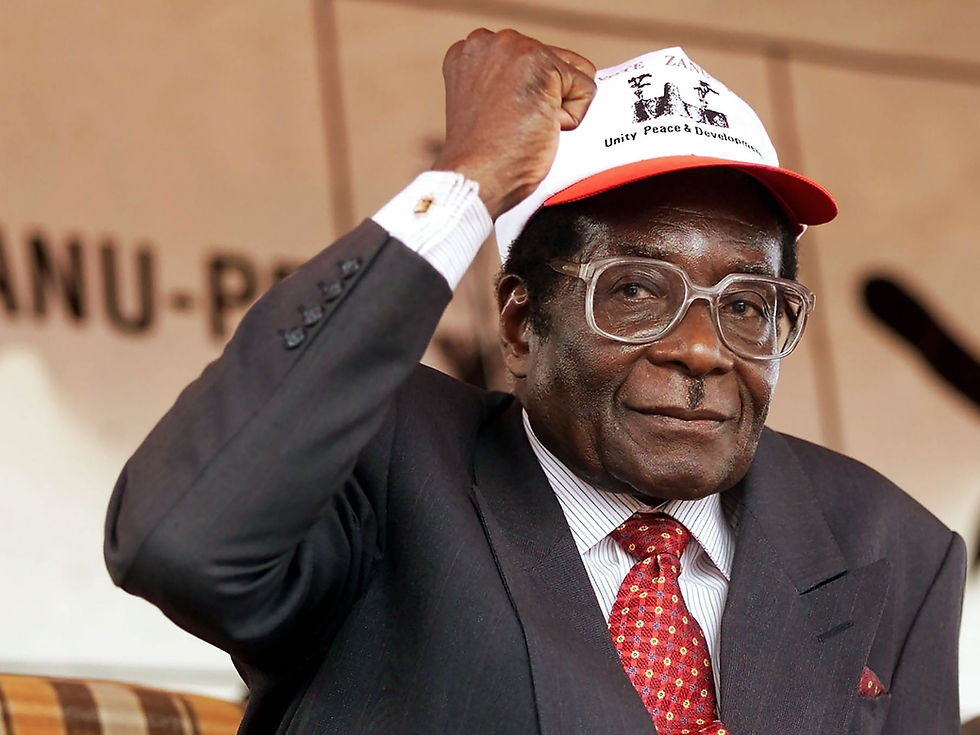
Over the past one week, colleagues and friends have been interrogating me about my position on the death of the Former President of Zimbabwe Robert Mugabe. Unlike most people who had “mixed feelings”, my position on the matter is clear.
To understand my position, I will bore you with the history of the nation state, which you already know of. In 1980 the Zimbabwean dollar (which had been introduced in 1970) was at par (1:1), at a similar value to the US dollar. The year on year inflation rose steadily as the government started spending more than they could earn. Corruption, followed by impunity fuelled by nepotism and rent-seeking dominated the economy. To understand the economic negligence, one has to understand the political economy of the state during this time. The entitlement by former freedom fighters who now occupied positions of power acerbated corruption and rent-seeking, in turn, the executive turned a blind eye due to the need to consolidate power. In the meantime, a crackdown in the southern parts of the state tantamount to genocide was taking place[1].
The situation got worse in the 90’s as the state sought redress of the ailing economy. It is at this point that the government approached the Bretton woods institutions for loans which came with a rift of policies under the banner of the Structural Adjustment Program. Again, not to bore you with the details, the Zimbabwe dollar became weaker due to de-industrialisation. Participation in the DRC war[2] did not make the situation any better for Zimbabwe, nor the huge pay-outs given to former freedom fighters[3].
Mugabeism was at its zenith from 1998 up to 2008. To me, this is the legacy of Robert Mugabe that all of us should never forget.
1998 food riots and the fast track land reform program
The economy of Zimbabwe had deteriorated such that between 19 to 23 January 1998, a wave of riots sprouted in major cities in the country. Mugabe deployed armoured troops to quell the protests. 10 people were shot during the crackdown on protestors in which 4 people died as a result of gunshots[4]. ZRP reported that 3,000 people were arbitrarily arrested nationally. Other human rights violations witnessed within this period included dragnet searches, police and army brutality, humiliating and degrading treatment and torture ibid. Fast forward to 26-27 February 2000, the Zimbabwe National Liberation War Veterans Association (ZNLWVA) organised war veterans to march on white-owned farmlands. In violent episodes which included torture, harassment, cruel inhumane and degrading treatment, white farm owners were forced off their lands along with their workers. An estimated one million black farm workers were displaced during the redistribution, leaving them without employment or land.
The major contribution of Mugabe’s land reform to the people of Zimbabwe is poverty, malnutrition, unemployment, and most importantly it destroyed hope for a better life for everyone born post-independence.
Operation Murambatsvina (2005)

The United Nations Special Envoy, deployed to Zimbabwe by the U.N. Secretary-General in June 2005, estimated that 700,000 people lost their shelter, livelihood, or both as a result of the evictions, and that about 570,000 of them have been internally displaced. During 2005 as is now, Zimbabwe was a nation in dramatic economic decline. More than 20% of the adult population was employed in the formal sector. Approximately 80% of adults in Zimbabwe therefore eke out an existence in the informal sector, either through subsistence farming or through informal employment in towns. By this means, they pay their rent, buy food for their children and send them to school. As many as 3-4 million Zimbabweans survive through informal employment. It is the unofficial backbone of the economy, and in a nation with no free health, housing or education, to remove the informal sector is to reduce Zimbabwe's poorest to a state of abject poverty.
In such a situation, the Mugabe led government destroyed infrastructure including vending stalls and temporary shelter for its citizens. It was assumed that the policy was retributive since most of MDC's 41 parliamentary seats were in urban constituencies, and one might have been to displace MDC supporters from urban centres into rural areas where they will be forced to tow the line by powerful, ZANU PF supporting traditional leadership, who control access to communal resources.
We have been out in the open since the end of May when our house was demolished during Operation Murambatsvina. We are not getting any assistance from anyone. I have two children staying with me but I sent the other two to the rural areas. My husband does not have a rural home and I don't think he would appreciate it if we went to my rural home. I don't have the money to send my children to school. The kids have colds because of staying outside and in the cold. I can't afford medical assistance. Sometimes we sleep without eating a meal or anything. We don't know what's going to happen once the rains come. (Displaced mother of four living by the edge of a forest in Victoria Falls, September 26, 2005.)[5]
2008 presidential run-off

There is a long history of impunity for serious human rights violations perpetrated by ZANU-PF and its allies when faced by political opposition. Beatings, intimidation and sporadic killings were part of every ballot since the opposition emerged as a coherent force in 1999. 2008 elections stand out as the epitome of a desperate attempt to consolidate power by the Mugabe regime. From January to December 2008, 6 cases of rape, 107 murders 137 abductions 1 913 cases of assault, 19 cases of enforced disappearances, 629 cases of displacements and 2532 violations on freedoms of association all linked to the elections[6]. ZANU-PF officials and "war veterans" tortured, assaulted and mutilated suspected MDC activists and supporters in hundreds of base camps, many of them army bases, established across the provinces. The violence was orchestrated by the Joint Operations Command, headed by senior ZANU-PF officials and includes the heads of the Zimbabwe Defence Forces, police, prison services, and the Central Intelligence Organization.
“One of the assailants lifted a gift that I had received from my husband and asked if he was good in bed which I did not answer,” she said. “He went ahead to ask “sei wakashamira mutengesi” (Why are you dressed in skimpy clothes for a sell-out). He walked towards me and lifted my nightdress and raped me once in front of my nine-month-old son.” Rutendo Munengami, wife of Glen View North MP Fani Munengami[7]
Operation Hakudzokwi November 2008 and January 2009
“The Untouchables of Chiadzwa are either slaving, wounded or dead. Those accused of damaging it may not use shovels, hoes or some such implements. They shall use their fingers, and accomplish the job in record time, these gwejas and gwejesses.” Nathaniel Manheru believed to be George Charamba (Reasserting authority in the wild, wild west, The Herald 24 November 2008)

Over 1 500 injured artisanal miners were rounded up by the army during a crackdown on artisanal diamond miners in Chiadzwa and thrown into crowded police cells with no access to treatment. Records at Mutare Provincial Hospital confirmed 150 bodies that had been received by the hospital mortuary from Chiadzwa on 5 November 2018[8]. Hospital staff confirmed that majority of the bodies had gunshot wounds. However, it was also learnt that some of the panners, very few in number, died due to diseases ibid. More than thirty panners died at Mutare Provincial Hospital from wounds inflicted on them by the soldiers, police and police dogs ibid. Abductions and torture of suspected panners from the surrounding communities by soldiers were common. The levels and extent of police brutality was appalling, including the arrest of children and women vending in the area, all rounded up in suspicion of illegal panning. Upon being rounded up the police would administer thorough beatings and set vicious police dogs on the suspects. Many sustained serious injuries from the beatings and dog bites. Magistrates in Mutare conducted mass trials for the suspects who were brought to court in groups of 10-12 and forced to make chorus pleas. Most of the accused panners had severe open wounds with puss oozing out. Some victims could hardly walk. Even with such evidence the magistrates did not order any inquiry into the circumstances in which these people got injured.
Conclusion
All of the aforementioned incidences of gross human rights violations, poor policy implementation which resulted in unemployment, meagre salaries and widespread poverty took place under the watchful eye of former president Mugabe and his prodigies. As a wise man once told me, “leadership” is about owning up to one’s choices, embracing failure and wrong decisions as much as one embrace success. A strong man stands up for himself, a stronger man stands up for others it’s up to you to decide if Mugabe stood up for others or not, as for me, my mind is set.
Gone but not forgotten
[1] During the Gukurahundi massacres in the early 1980s in Matabeleland and Midlands provinces, Mugabe ordered the army’s Fifth Brigade to conduct counterinsurgency operations against “dissident” ex-guerrilla fighters that led to the deaths of at least 10,000 civilians and the enforced disappearances, arbitrary detention, and torture of countless others (https://www.hrw.org/news/2019/09/06/robert-mugabe-leaves-behind-legacy-abuse-0)
[2] The war cost $27 million a month. The government failed to pay back IMF loans due to this heavy expenditure. The IMF reacted in 1999 by freezing a $193 million funding package for Zimbabwe (http://www.thezimbabwean.co/2016/10/how-mugabe-double-crossed-joseph-kabila-the-drc/)
[3] war veterans under the command of the late Chenjerai Hitler Hunzvi in 1997 forced Mugabe to award them Z$50 000 gratuity each totalling Z$4,5 billion plus monthly pensions for life . https://bulawayo24.com/index-id-opinion-sc-columnist-byo-59481.html
[5] https://www.hrw.org/report/2005/12/01/zimbabwe-evicted-and-forsaken/internally-displaced-persons-aftermath-operation


Comments